Your Local Mortgage Lender
Located in Orange, California
Personalized Mortgage Experience
Bruce Byrwa offers personalized service and loan options you'll love. We shop multiple lenders to find the best rate and product for you, getting you into your dream home faster.
With wholesale interest rates and cutting-edge technology, we make the mortgage process seamless. Trust the experts who focus solely on mortgages. Support your local community and experience elite client service.
Let us help you achieve your homeownership dreams!
The Home Loan Process
Mortgage Pre-Approval
Get pre-approved from one of our Loan Officers to see how much you can afford.
House Shopping
Work with a trusted Real Estate Agent to find a home you would like to move into.
Loan Application
Complete your home loan application to get the lending process started.
Don't take my word for it
Mortgage Programs
Experience the best mortgage experience located in Orange, California.
Home Loan Options
Our experienced mortgage advisors will walk you through the best mortgage loan program that will fit your specific scenario.
Conventional Home Loans.
FHA Home Loans.
USDA Home Loans.
VA Home Loans.
Frequently Asked Questions
How often can I refinance my mortgage?
There is no limit to the number of times you can refinance. However, you must qualify every time you apply and there will be costs associated with closing the loan each time.
Can I buy a home if I do not have money for a down payment?
Yes! There are a number of bond programs that offer low or no down payment financing options.
How do I know which mortgage is right for me?
The key to choosing the right mortgage is to understand the range of options and features available to you, as well as your budget, circumstances, and goals. Our licensed mortgage professionals are here to help you navigate that process. The more you know, the more comfortable and confident you will be choosing the best option for you and your family.
How long will the loan process take?
The Truth in Lending Act (TILA) does not permit a lender to close a loan until at least seven (7) business days have passed from the date your application was received. A typical home loan takes 30 days, as a number of third-party services such as appraisals, title work, and credit are required in conjunction with the mortgage process. Once you familiarize your Loan Officer with the details of your specific loan scenario, they will be able to provide you with a more specific timeline.
Will I qualify for a home loan?
The only way to find out is to speak with a qualified mortgage professional. Our Loan Officers have helped numerous clients who didn’t know if they could qualify to become home owners. We take the time to understand your financial situation and long-term financial goals, and then match you with the loan program that best fits your needs. Your approval for a loan may also largely depend on the price of the home you are financing. Getting pre-qualified prior to beginning your home search can give you an idea of what you may be able to afford.
Why do people refinance their mortgages?
Homeowners typically refinance to save money, either by obtaining a lower interest rate or by reducing the term of their loan. Refinancing is also a way to convert an adjustable loan to a fixed loan or to consolidate debts.
How much money will I have to pay upfront to buy a home?
This question does not have a simple, one-size-fits-all answer. The exact amount will depend on the price of the home you buy as well the type of mortgage financing you choose. Depending on your loan program, your down payment could be as much as 20% of the home’s price or as little as 3%, while some loans require no down payment at all.
Can I get a mortgage after bankruptcy?
You may still qualify for a home loan even if you have experienced a bankruptcy. The best way to find out if you qualify is to talk with a Loan Officer to discuss your options. Be sure to bring all paperwork regarding your bankruptcy so your Loan Officer can find the program that best fits your situation.
Should I lock my interest rate now, or wait until we are closer to our closing?
Interest rates fluctuate all day, every day. If an interest rate is good, it may be in your best interest to lock now. If you wait, you run the risk of an increase in rates later. If you are concerned that rates may go down after you lock, contact your Loan Officer to discuss your options. Some programs allow you to lock for an extended period and choose to lower your rate should a better one become available.
Most Recent Blog Updates
How Much Money Do You Actually Need to Buy a House and the Answer Will Surprise Most People
The Imaginary Roadblock That Is Keeping Too Many People From Buying
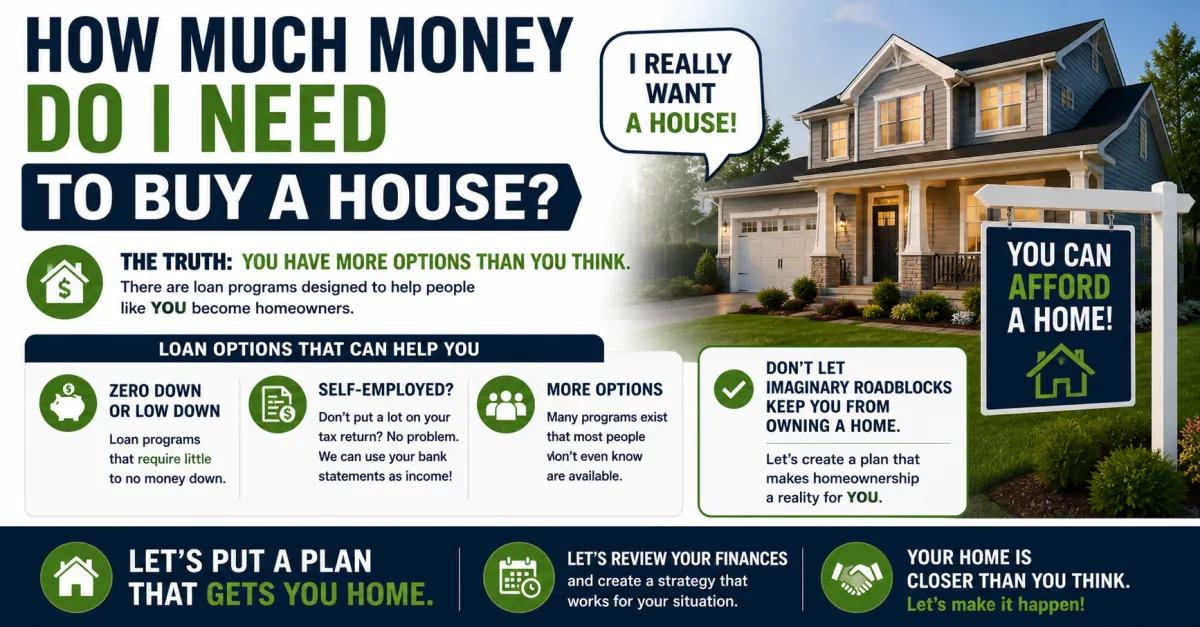
How much money do you need to buy a house? It is one of the most common questions Bruce Byrwa at JC First Mortgage hears and it is also one that reveals how many people have built imaginary roadblocks in their heads about what homeownership actually requires.
Most people assume the number is large. A significant down payment. Years of savings. Perfect credit. A tax return that shows substantial income. The reality is considerably more accessible than that assumption and the gap between what people believe is required and what programs actually allow is keeping a lot of people on the sidelines who could be buying right now.
Zero Down and Very Little Down Programs Exist and Most People Do Not Know It
Bruce Byrwa has loan programs available with zero down payment requirements. Others require very little down. These are not obscure products or workarounds. They are legitimate loan programs designed for borrowers who are ready to own a home and can afford the monthly payment but have not accumulated a large down payment yet.
VA loans for eligible veterans and active duty service members offer zero down payment with no private mortgage insurance. USDA loans offer zero down in eligible rural and suburban areas. FHA loans require as little as 3.5 percent down. Down payment assistance programs available at the state and local level can cover some or all of the remaining requirement for qualifying buyers.
The specific program that fits depends on the borrower's situation, income, credit profile, and the location of the property being purchased. But the idea that a buyer needs 20 percent down before they can have a conversation about homeownership is simply not accurate and that misconception is costing potential buyers the time and equity they could be building right now.
For Self-Employed Borrowers Whose Tax Return Does Not Tell the Whole Story
For self-employed borrowers the down payment is often not the obstacle. The obstacle is the tax return. Business owners who work hard for every legitimate deduction they can take end up with a tax return that shows significantly less income than what they actually earn and bring home. Conventional mortgage underwriting uses that tax return number to determine qualifying income and the result is that financially capable self-employed buyers get declined or qualify for far less than their actual financial position supports.
Bank statement loan programs address this directly by using actual deposits into business or personal accounts over twelve to twenty-four months rather than what the tax return shows. The deposits reflect what the business actually produces. That is the income figure that gets used for qualification rather than the number that reflects a smart tax strategy.
Self-employed borrowers who have been told they cannot qualify because of what their tax return shows may find that a bank statement program produces a completely different and more accurate result.
The Right Move Is a Real Conversation
The only way to know what you actually qualify for is to sit down and go through the specific numbers. Income, credit, savings, the type of property being considered, and the location all factor into which programs are available and what they make possible.
Bruce Byrwa at JC First Mortgage works with buyers at every financial starting point to build a plan that gets them to homeownership based on their actual situation rather than a generic assumption about what it takes. Reach out to Bruce Byrwa to sit down, go through your finances, and find out what your path to buying a house actually looks like right now.
Sources
VA.gov
USDA.gov
HUD.gov
ConsumerFinancialProtectionBureau.gov
MortgageNewsDaily.com

Mortgage Calculator
See your total mortgage payments using the tool below.
| Year | Interest | Principal | Balance |
|---|